
Mercer Historical Directory Holdings
Mercer’s strongest historical directory shelf is centered on Trenton. The Trentoniana microfilm inventory lists city directories from 1845 through 1971, while the Trenton Historical Society describes the earliest business books and later household editions in more detail. A directory is an edited publication, not a government roll. It may list a home, a boarding place, a business, or several people tied to one address. Use the published year as the date of the entry, then preserve the spelling and abbreviations before comparing another source.
| Collection | Years | Where Held | Access |
|---|---|---|---|
| Trenton city directories | 1844/45 business, 1854, 1857, 1859, 1865-1939, 1945-1971 | Trentoniana; selected editions at Trenton Historical Society | In-room, with selected editions online |
| Trenton telephone directories | 1925-1970 listed | Trentoniana | In-room; verify a specific reel or date first |
| Digitized Historical Society editions | 1844, 1859, 1877 partial, 1881, 1882, 1900, 1920 | Trenton Historical Society | Searchable online OCR and page text |
| Redi Realty Guide and property material | 1983-1991 and 1992 onward listed | Trentoniana | In-room address and property context |
The listed sequence has a real gap, rather than an error in a name search. Publication continued annually or biennially to 1939, paused during 1939-1945, and resumed through 1971. Holdings lists are still updated, so a call before a visit is sensible when a single volume matters.
Note: Treat the holdings list as a guide, then confirm the exact reel, shelf volume, or scanned title page before relying on it.
Mercer Directory Timeline
Trenton’s directory history changes what an entry can prove. The first local book was business-only, so it cannot stand in for a household list. Household listings arrived later. The long later run is particularly useful because it gives repeated chances to test a move, a changed occupation, or a new widow notation.
- 1844: Trenton’s first directory appeared as a business book.
- 1854: Household listings began, followed by 1857 and 1859 editions.
- 1865-1939: Publication resumed and continued annually or biennially.
- 1939-1945: The documented publication gap interrupts the sequence.
- 1945-1971: The directory run resumed; Trentoniana separately lists telephone books for 1925-1970.
The Trenton Historical Society directory history notes an 1844/1845 catalog-label difference. Check the individual scanned title page if the exact first-book date affects a citation.
Trentoniana's Mercer Directory Shelf
The Trentoniana Room at the Trenton Free Public Library is the in-person route for directories, telephone books, maps, tax cards, newspapers, yearbooks, and related local material. Its collection is at 120 Academy Street in Trenton. Materials remain in the room and cannot be checked out. Pencils, staff direction, and the collection’s copying rules matter, especially for manuscripts and photographs. A short remote research inquiry is available when an in-room visit is not practical.
The Trenton Historical Society also offers a limited paid route: one name in a ten-year directory span is $10, and volunteers may have delays because they use the Trentoniana collection during limited hours. Mail requests go to the Society with the surname, given name, and decade. This is a narrow lookup service, not a substitute for examining every possible year.
Decode Mercer Directory Entries
A Mercer city directory entry usually starts with a surname and given name or initials. It may then give an occupation, a firm, a business location, a residence, and a household status abbreviation. The 1859 and 1900 Trenton texts show why exact transcription helps: a street number, a cross-street phrase, an employer, and a widow notation can all separate similar names. A company listed beside a person may identify work or affiliation, but it does not establish that the person lived at that business address.
| Headword | Surname plus given name or initials, using the period’s spelling and punctuation. |
|---|---|
| Occupation or firm | Work, trade, employer, or business association that can distinguish people with the same name. |
| Home line | h means home; a street, number, or cross-street phrase follows it. |
| Boarding or residence | bds means boards, while res means resides or residence. |
| Widow and repeat address | wid identifies a widow notation; do repeats the preceding address, as in “h do.” |
- Criss-cross directory
- An address-first or street-order section that can lead from a location to listed occupants when that type of volume is available.
- Householder index
- A list organized around the named household contact, which may omit boarders, lodgers, and other people at the address.
- Abbreviation key
- The edition’s front matter that defines its own short forms, street directions, and location language. Photograph or transcribe it before interpreting entries.
Note: Keep an image or transcription of the abbreviation key because location language can differ from one directory edition to another.
Mercer Directory Abbreviations
The old shorthand carries facts, not decoration. “H Broad n Livingston” places a home on Broad near Livingston, while “h 189 Warren” gives a numbered home. The Society’s 1859 text includes both forms. The 1900 text pairs an occupation with “h 38 Belvidere” and shows “wid Frederick, res 852 Lamberton.” Read north, south, east, west, corner, below, between, and avenue or street language against the key in that volume.
The searchable 1859 Trenton directory text provides a direct view of these entry patterns.
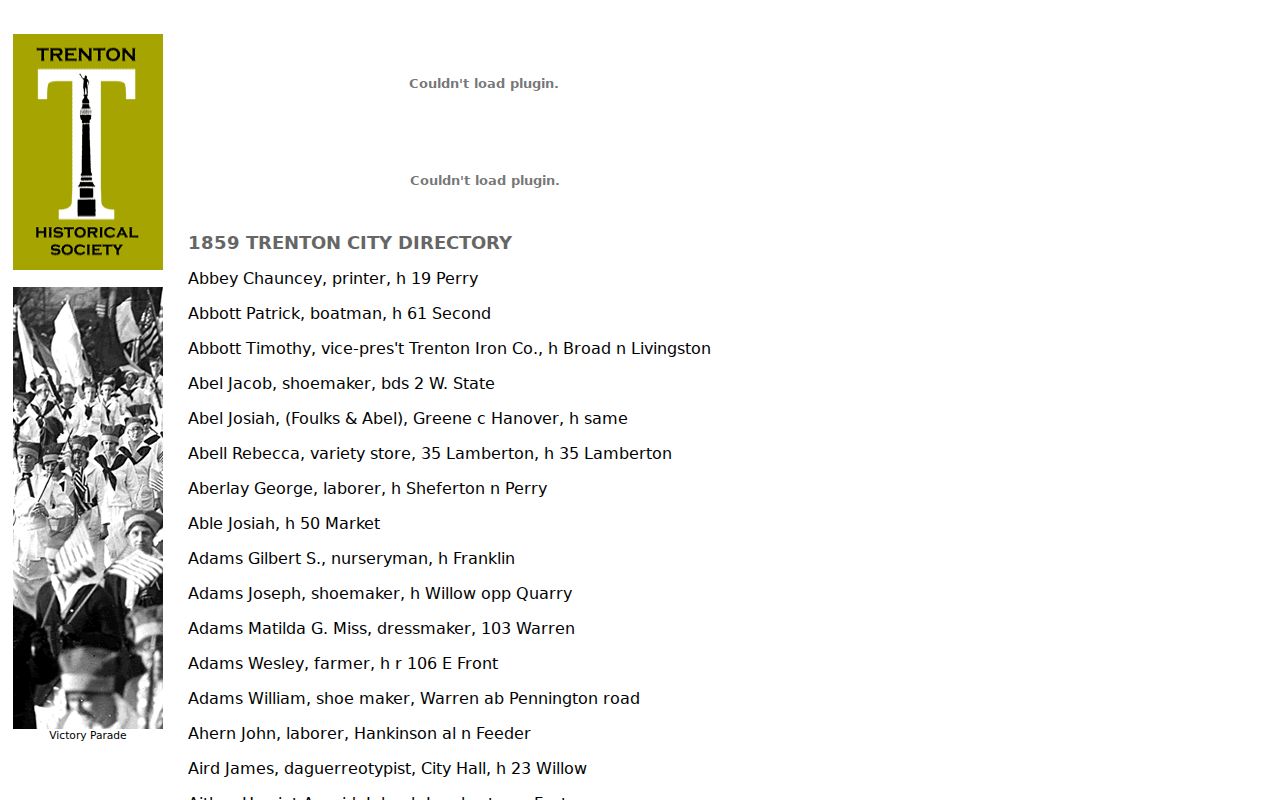
The entry display makes the home, boarding, widow, and repeat-address conventions easier to compare with a transcription. It still needs a date and another record before it supports a household conclusion.
Trace Mercer Directory Households
Follow one name through successive directory years, but do not jump from one volume to the next without writing down the exact street, occupation, and notation. A move may be real, yet a changed surname, initials, boarding location, firm name, or widow entry can also keep the same person from appearing under an expected form. The address-first route is useful only when a street or reverse directory exists; standard alphabetic volumes are name-first.
- Find the earliest likely surname and given-name form in a dated volume.
- Record the address, occupation, employer or firm, and each abbreviation exactly as printed.
- Check a later edition at a five-to-ten-year interval, including initials, married names, and widow forms.
- Use a street or criss-cross section, when held, to see other listed people at the address.
- Pair the dated entries with the closest available census, map, newspaper, or tax-card evidence.
Disappearance has several possible meanings. A person may have moved, died, married, changed a business, boarded elsewhere, or simply been omitted. Nearby years, obituary dates, and the tax or map layer help test those possibilities.
Mercer Directories and Census
Directories fill the long spaces between censuses, while censuses can show a fuller household at one point in time. The latest generally public federal census is 1950 under the 72-year rule. Trentoniana also lists New Jersey Trenton census material for 1895, 1905, and 1915, plus selected federal New Jersey reels. Enumeration dates and boundaries can differ from a directory’s publication date, so a similar address is a starting point rather than an automatic match.
For older names, the New Jersey State Archives genealogy collections add county records, naturalizations, historical vital sources, military material, and newspapers. Mercer naturalization indexes cover 1838-1930, with declarations through 1940, and can add origin, sponsor, spouse, children, and residence details.
Note: Record the census enumeration date and the directory year separately before treating a move as established.
Mercer Directory Companions
Trentoniana’s shelf works best when its formats are used together. Telephone directories are listed from 1925 through 1970. Tax cards cover most of Trenton in the 1930s through 1950s, with notes in some cases extending into the 1960s. They can add an assessment clue, property note, or photograph, but they are not proof that every named person occupied the property. Redi Realty Guide listings add later property context.
Sanborn maps and atlases help with an address that does not look the same on a current street. The Trentoniana maps and directories collection describes maps that show building outlines, construction, streets, house or block numbers, use, and sometimes factory owners. Those details can bridge an old number or building footprint; they do not replace a deed or prove title.
Old entries often use industrial work terms such as potter, wiredrawer, rail worker, or factory manager. Those terms can be useful search terms in newspapers, business records, and historical-society collections.
Note: Record the evidence type and its date separately when pairing a tax card, map sheet, telephone book, and directory entry.
Mercer Directory Search Tips
OCR is helpful but not final. Old type can make a name unreadable to a text search, so try surname variants, initials, an occupation, a firm, and an address. The digitized Trenton Historical Society set includes 1844, 1859, partial 1877, 1881, 1882, 1900, and 1920 editions. When an online search fails, the readable page image and the in-room shelf are the practical next steps.
For a precise remote request, give the Society the name and a ten-year span. Its research page also lists a dated obituary lookup for $8 and a yearbook copy for $7 when the needed date and school details are supplied. A broad request cannot be answered from a single directory line.
Limits of Mercer Directories
A city directory does not list every renter, child, guest, boarder, or person who later used an address. Shared addresses can identify relatives, employees, lodgers, or unrelated residents. Directory publication dates also leave gaps, especially around 1939-1945. Treat a listing as a dated association to the address or firm, then confirm the relationship with a census, tax card, map, obituary, probate file, or recorded document suited to the question.