
Mercer Address Records by Era
One Mercer address can leave several trails, and each answers a different question. Recorded deeds track transfers. Directories and census schedules can show people listed at the location. Tax cards, maps, and permits add property context. Begin with the newest reliable parcel detail, then choose the source that spans the period in question. A gap in one series is a reason to move to the next source, not to guess who lived there.
| Source | Years It Covers | Where Held | What It Shows |
|---|---|---|---|
| Mercer Official Records | Recorded real-property records since 1838 | County Clerk public search and Records Room | Grantors, grantees, recording dates, book/page, legal text, linked documents |
| Trenton city directories | 1845-1971 listed | Trentoniana; selected editions online | Listed households, work, and dated address clues |
| Telephone directories | 1925-1970 listed | Trentoniana | Later name and address clues |
| Tax cards and property material | Most of Trenton, 1930s-1950s; some notes into the 1960s | Trentoniana and selected Historical Society material | Assessment, property notes, and sometimes photographs |
| Federal census | 1830-1950 publicly available | NARA, libraries, and genealogy services | Household composition at the census date |
| Municipal permits | Varies by municipality | Municipal construction office or OPRA request | Applied-for or completed work and address history |
For an address in Trenton, historical holdings have a strong local route. Elsewhere in Mercer, first confirm the taxing municipality because postal city names do not always match the municipal record keeper.
Start Mercer Address Records
Start with the present parcel key, not a remembered street name. The New Jersey Municipality Address Lookup can standardize an address and identify its municipality. Then the New Jersey Property Explorer can supply property location, municipality, block and lot, annual assessment context, and an owner name when the public layer makes it available. Save the situs address, the physical parcel location, separately from the mailing address, which may be an office, trust, or another residence.
The county Property Information Portal is closed to ordinary public users under Daniel’s Law. NJGIN map layers remain useful for parcel shape and identifiers, but hosted public layers redact owner names and are not legal boundary determinations. Block, lot, and the deed’s legal description are more dependable bridges than a street number when the address wording changes.
Note: A current tax-list association may lag a later recorded deed because statewide annual tax data reflects the list filed in January.
Mercer Deed Records Backward
The deed chain is a record of ownership, not a list of every resident. Use the parcel key to search the Mercer Official Records public search by Town plus Lot/Block or Legal Description. If a party search is needed, enter the owner last name first and without a comma, then narrow by DEED and a date range. The result detail can show document type, instrument number, recording date and time, book/page, consideration, legal information, linked documents, and referring documents.
The Official Records search screen documents the fields that make a backward search more precise.
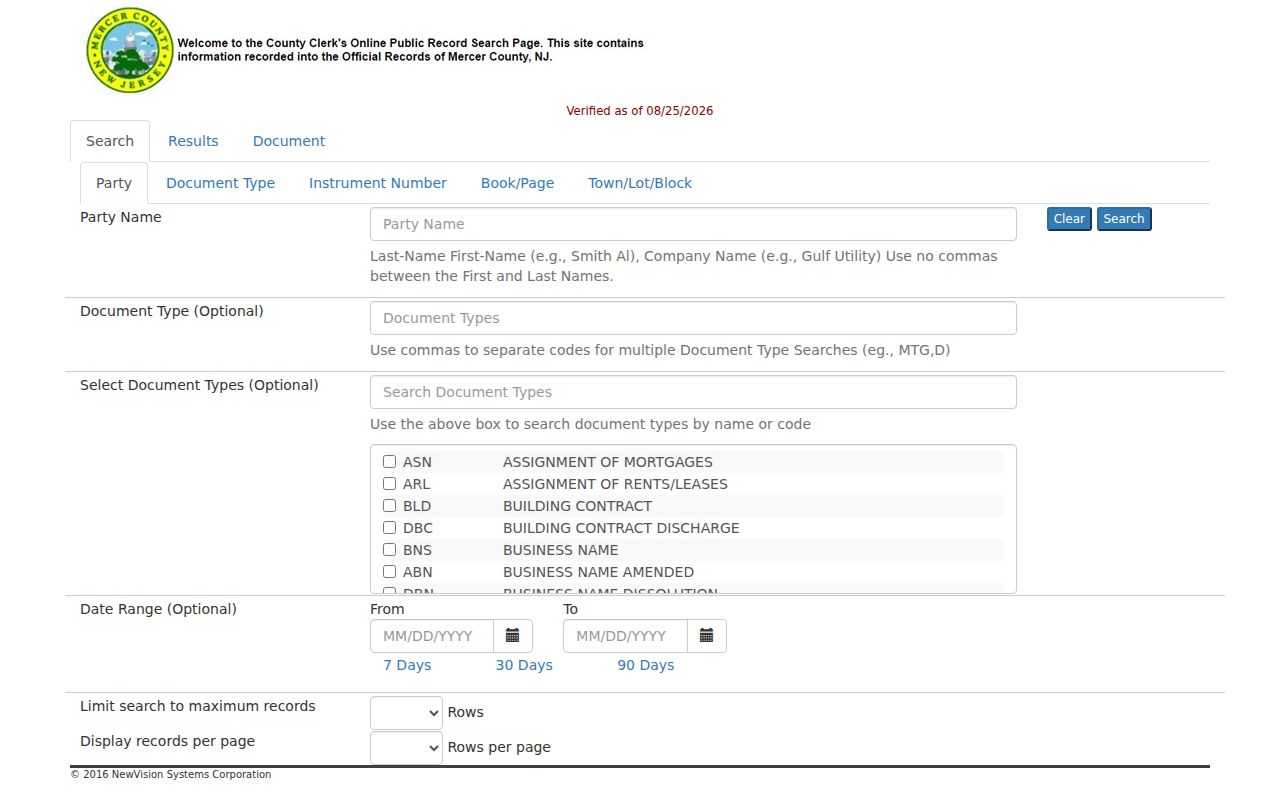
Use a narrow party, date, town, lot, block, or legal-description search to avoid a broad name result. The interface marks replaced records with R, corrections with C, and unverified party records, so inspect the selected document rather than relying on a result row alone.
- Record the current municipality, block, lot, legal description, and owner from the tax or parcel source.
- Locate the current owner’s purchase deed in the Clerk index and record the grantor, grantee, instrument, date, and legal description.
- Search the seller, usually the prior grantee, with the same parcel identifiers to find that person’s earlier purchase.
- Repeat backward, trying initials, married or widow forms, trusts, estates, and company names when the party changes form.
- Move to earlier books or indexes when the online search does not reach the needed period or lacks an image.
- Grantor and grantee
- The grantor transfers an interest in a deed; the grantee receives it. These roles are read from the document, not inferred from a current address.
- Chain of title
- The sequence of recorded transfers connected by the same parcel and legal description.
- Legal description
- The lot, block, map, subdivision, metes-and-bounds, or other property wording in a deed. It is often more stable than the street address.
Mercer Records Room Fallback
The online index does not publish one current starting year for every historical document. A county notice about an earlier McPress search said it reached about 1997, but the current Clerk pages do not promise that as a present cutoff. For earlier deeds, missing images, books, maps, or an index question, use the physical route described on the Mercer County Clerk land-records page: the Records Room at 209 South Broad Street is open weekdays from 8:30 a.m. to 4:30 p.m.
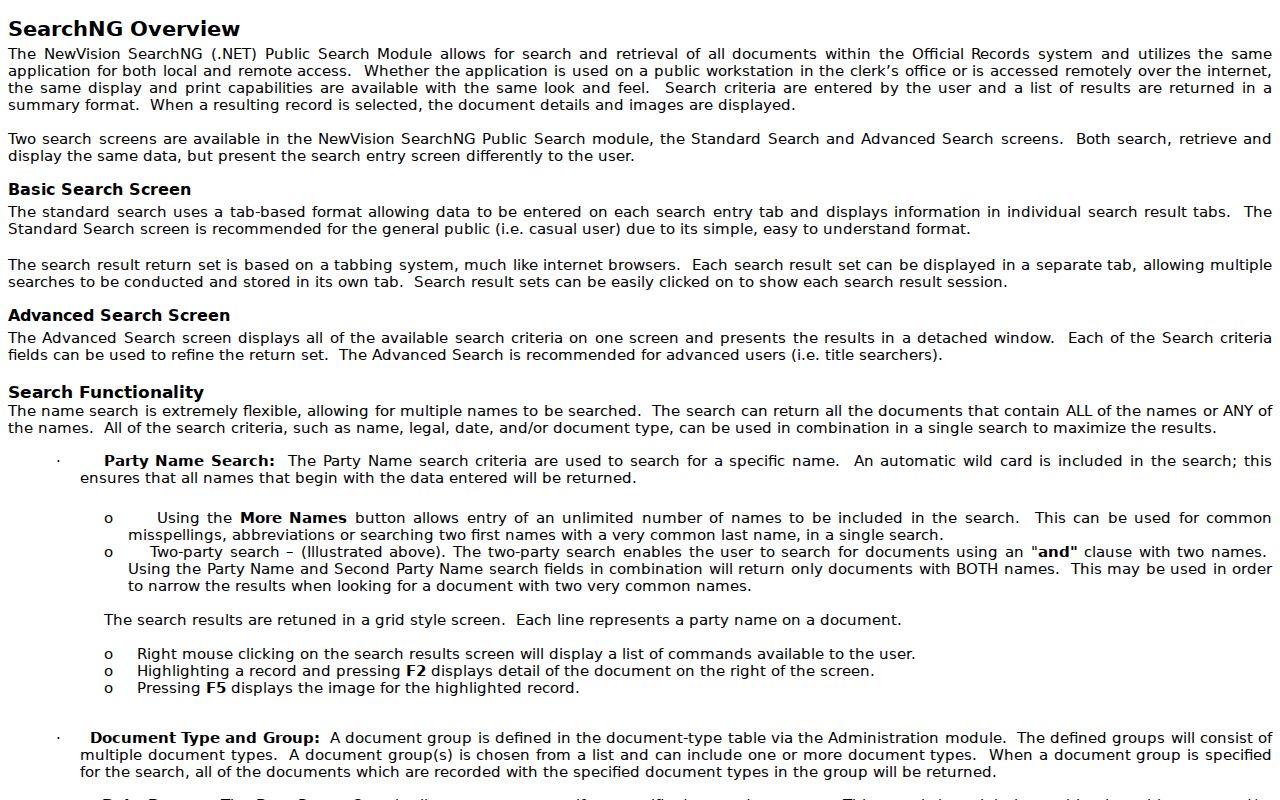
The NewVision SearchNG help explains the Standard and Advanced search behavior, legal and map searches, result sorting, and image access.
Staff may explain how the computerized index works, but they cannot conduct a title search for the visitor. Bring the municipality, block and lot, a book/page or instrument number when known, and the legal-description wording. Indexing can answer map-copy questions at 609-989-6476.
Mercer 1838 Address Records
Mercer County was created in 1838 from parts of Hunterdon, Burlington, Middlesex, and Somerset counties. The Clerk’s land-record coverage begins with Mercer’s incorporation, so an address trail that reaches the 1830s may need a predecessor-county book rather than a Mercer volume. Trenton became the county seat, but the old county boundary does not make earlier records disappear from the counties that supplied its territory.
That boundary rule matters when a deed sequence stops at the county’s beginning. Compare the legal description, older map wording, and adjacent parcel names before sending the search to a predecessor county. No official source reviewed documented a countywide street-renumbering year, so do not assume a changed number has one countywide explanation.
Note: A predecessor-county search should preserve the old legal locality, not merely the modern Mercer street address.
Mercer Household Records Beyond Deeds
Owners are only half the story. Directory and census work can show who was listed at the address, but a listing does not prove every person who stayed there. The Trenton Historical Society’s searchable 1859 text gives names, occupations, home or residence wording, boarding status, and street clues. The collection itself is covered in the Mercer city directories section, while this address trail uses the volumes as dated household evidence.
The 1859 Trenton directory transcription illustrates the mix of name, work, home line, and address shorthand found in historical entries.
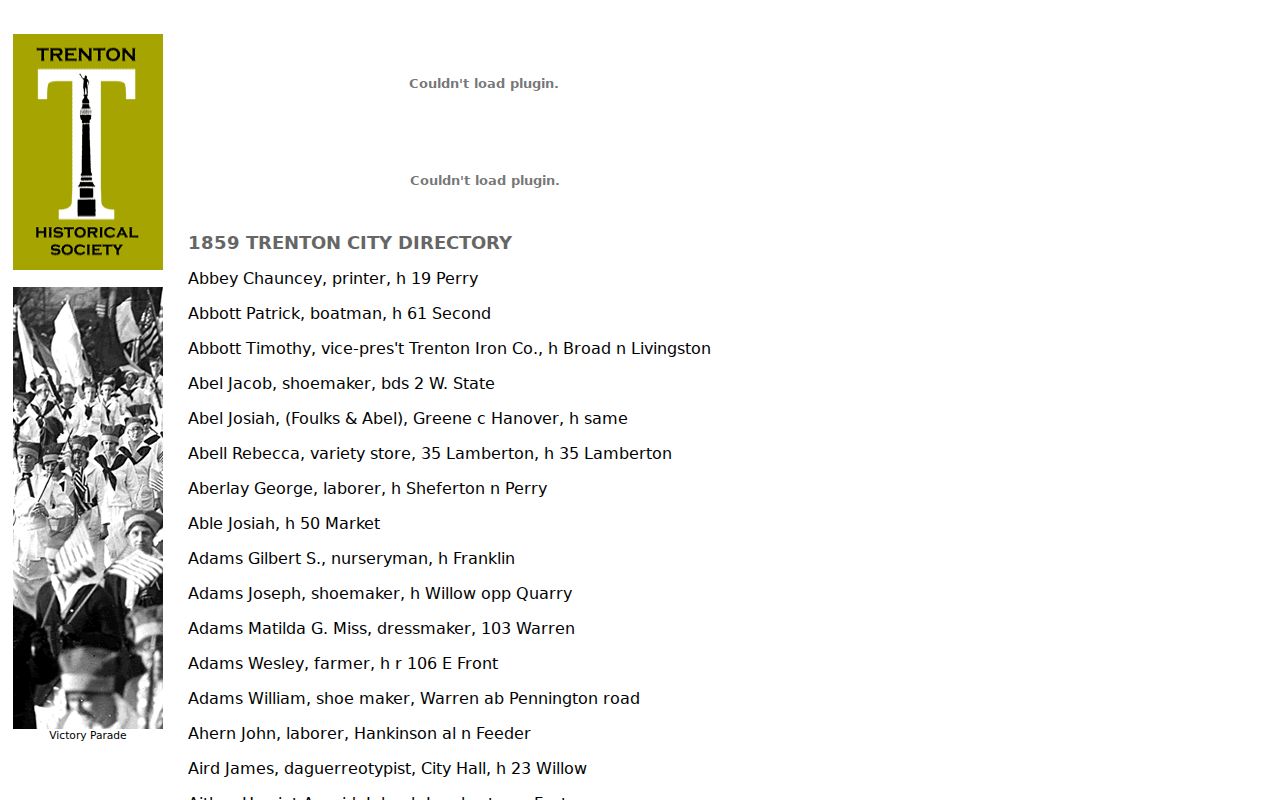
An entry may use h for home, bds for boards, res for residence, wid for a widow notation, and do for a repeated address. Preserve that language before normalizing it into a modern address.
- Choose a directory year near the transfer or tax-card date already found.
- Record the exact name, address, work, household shorthand, and spelling from the entry.
- Compare the nearest federal census, noting that its enumeration date differs from the directory’s publication date.
- Check nearby directory years, telephone books, and newspapers when the name disappears or changes form.
The latest generally public federal census is 1950 under the 72-year rule. Trentoniana also lists Trenton state census material for 1895, 1905, and 1915, making it possible to test a directory clue between federal census dates.
Note: Census and directory dates are separate evidence points, even when the person and address look like a close match.
Mercer Address Records on Maps
Tax cards and maps can anchor the address while the deed chain moves through different owners. Trentoniana holds tax cards for most of Trenton from the 1930s through the 1950s, with notes in some cases into the 1960s. The card may add an assessment, property detail, or image, but it is not a title record and does not prove that every named person lived there. It works best as a date bridge between a directory and a deed.
Sanborn maps are another bridge. The Trentoniana map and directory holdings describe sheets that show building outlines, size, construction, street and sidewalk width, property boundaries, use, and house or block numbers. They can explain an older number, a building footprint, or a changed block description. They cannot establish title, and parcel polygons should not be treated as survey boundaries.
Mercer Address Record Permit Trail
A permit can date an alteration, use change, or inspection at a Mercer address. It can also name an applicant or owner, but that name is evidence of the filing, not proof of residence or ownership. Permit records are municipal, so route the request to the town that governs the parcel. For Trenton, the Division of Inspections identifies building, plumbing, electrical, fire-protection, elevator, zoning, and maintenance channels.
No countywide public permit search was located. When a municipal search is not posted, ask the local records custodian for a narrowly dated permit register, certificate of occupancy, inspection record, or zoning/land-use decision by address. A formal OPRA request must go to the responsible municipal custodian; a phone call alone is not an OPRA request.
Note: Keep permit dates separate from deed dates because construction activity does not itself transfer the parcel.
Mercer Estate Record End Routes
When the address trail reaches a death, estate, or departure, probate and obituary records can provide a closing date or a next research path. The Mercer County Surrogate estate-search page reports index books for 1838-1956, microfiche from 1956 to the present, and a computerized directory from mid-1991. Public inspection is available at 175 South Broad Street in Trenton. The page lists a $10 search fee and $3 per page for copies.
A will becomes public after probate, but it is not a full address-history record. The Trenton Historical Society offers a dated obituary lookup for $8 when a complete obituary date is supplied. Trentoniana newspaper microfilm, cemetery records, and the State Archives can offer other historical endpoints. Verify a person’s relationship to the address with the dated record rather than treating an obituary mention as proof of occupancy.
Lawful Mercer House History
House-history research is strongest when each fact stays tied to its source and date: a deed associates parties with a recorded transfer, a directory lists a person at a dated address, and a tax card records property context. Keep living people’s privacy in view. New Jersey’s Address Confidentiality Program and Daniel’s Law can limit address information, and redacted or absent information should not be treated as an invitation to search around those protections.